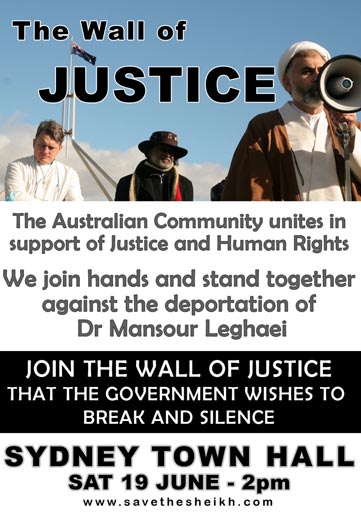
The following article was written by Ben Saul,  Associate Professor of International Law at Sytdney University.  It first appeared in the Sydney Morning Herald, Monday June 7th.

In Franz Kafka’s novel The Trial, an ordinary man finds himself trapped inside the byzantine processes of a shadow justice system. When he asks what he has done wrong, the bureaucrats reply, “It’s not our job to tell you that.”

When he goes to court, he and his lawyers are not allowed to see any of the evidence against him.

His faceless accusers always remain unknown to him. Inevitably, in a system such as this, he is found guilty. All around him, life continues as normal, as if the fair trial of one man is of no concern to the world.

Kafka’s story is a terrifying glimpse into a world which, on the surface, claims to be ruled by law, but in reality is one where the modern bureaucratic state exercises total control over the individual. The individual’s right to be treated decently is extinguished for an unknown greater good. Kafka was writing about rising authoritarianism in early 20th-century Europe, but he could well have been describing Australia’s migration and security laws.

Mansour Leghaei is a long-term resident of Australia soon to be deported to Iran on national security grounds. All he has been told by the intelligence agency ASIO is he is a risk to national security. He has been shown no evidence by ASIO or in any of the court proceedings he brought to challenge ASIO’s assertion.

Absurdly, he has received letters from the authorities asking him to answer the allegations against him, when he has no idea what they are. A Federal Court judge observed his right to procedural fairness had been reduced to ”nothingness”.

Because Australia has no bill of rights, in Leghaei’s case, Australian law cares nothing for the right to a fair hearing of foreigners in security cases. This places Australia in direct breach of its international law obligations under the human rights treaties which it agreed to. Human rights law recognises the importance of a country’s security concerns, but requires minimum guarantees of fairness for an affected person.

The Australian approach is at odds with much of the liberal democratic world. In Britain and continental Europe, which face greater security threats than Australia, human rights law requires a person to be told the substance of the allegations. Sources and informants and other sensitive information can be protected, but an affected person must always receive a summary of the reasons and evidence. That delicate balancing of interests is a sign of living in a civilised society bound by the rule of law.

The denial of a fair hearing is foreign to our ancient common law tradition. The common law depends on an adversarial process, in which a person can challenge the evidence against them. Only be exposing allegations to the harsh light of day can their truth be tested.

Allegations may be false, informants may bear grudges, conduct may have innocent explanations, and intelligence may be misinterpreted. Few can forget that Iraq was invaded in 2003 based on botched intelligence; no reasonable Australian can have blind faith in ASIO.

Where a person is unable to see or test the evidence, it cannot possibly be determined whether the person is actually a risk to national security or not. Deporting Leghaei in such circumstances would be arbitrary, capricious, and internationally unlawful.

It would also deprive Australia of a moderate religious leader and voice of tolerance, as well as depriving his children, who are Australian citizens, of their father. As a Federal Court judge said: “His deportation may well cause hardship to utterly blameless Australian citizens and permanent residents”.

For that reason, the United Nations Human Rights Committee has ordered Australia not to deport him until the UN has ruled on his complaint against Australia.

The UN’s temporary order aims to prevent the ”irreparable harm” to the Leghaei’s family life which will result if he is torn apart from his wife and children – including his 14-year-old daughter, who will lose her father – by deportation. The UN’s order is binding under international law, necessary to ensure the procedural integrity of the complaints system.

While the Rudd government talks the talk of human rights and global governance, signing up to every treaty under the sun, it is in individual cases the rubber hits the road.

By announcing that it will deport Leghaei in defiance of the UN’s order, the government has revealed its true colours and its contempt for international law.

Its commitment to the UN system is flaky and selective. Kafka Kevin’s hypocrisy is remarkable, particularly when a tedious and splenetic Opposition turns up the heat on immigration.

Leghaei’s request of the government is not radical: tell him what he has supposedly done, let him explain it, and only then deport him if the allegations are true.

That is what a fair and civilised society ruled by law would do.

No Australian can have confidence in our security where it is based on faceless accusers and secret evidence – and where ordinary people are judged in the shadow of the law.

Professor Ben Saul

Assoc. Professor Ben Saul

Share and Enjoy:
  • Digg
  • del.icio.us
  • Facebook
  • NewsVine
  • Reddit
  • StumbleUpon
  • Google Bookmarks
  • Yahoo! Buzz
  • Twitter
  • Technorati
  • Live
  • LinkedIn
  • MySpace
  • MySpace

Thursday, June 3rd 2010, more than 1000 men, women and children travelled to Canberra to march on Parliament House, calling on the Australian government to heed the request of the United Nations and halt the deportation of Sheikh Mansour Leghaei.

The event was covered on a variety of TV News stations and in all the major papers.

Links to other TV and Newspaper coverage:

International coverage:

Sheikh’s supporters protest against his deportation

Share and Enjoy:
  • Digg
  • del.icio.us
  • Facebook
  • NewsVine
  • Reddit
  • StumbleUpon
  • Google Bookmarks
  • Yahoo! Buzz
  • Twitter
  • Technorati
  • Live
  • LinkedIn
  • MySpace
  • MySpace

The following is an open letter from the supporters of Sheikh Mansour Leghaei to Australian Prime Minister Kevin Rudd.

The Hon. Kevin Rudd, MP
Prime Minister of Australia
Australian Parliament
Canberra, Australian Capital Territory, 2600

June 3, 2010

Dear Prime Minister

Re: Request to prevent the deportation of Sheikh Mansour Leghaei in accordance with the communication of the United Nations Human Rights Committee of 21 April, 2010.

We are supporters of Sheikh Mansour Leghaei, a moderate Iranian cleric who leads the 1500-member Imam Husain Islamic Centre in Earlwood and is the elected head of the local Interfaith Committee.

As you will be aware, Dr Leghaei and his family have lived peacefully in Australia for 16 years. His application for Permanent Residency in Australia has been denied due to two Adverse Security Assessments issued by ASIO in 1997 and 2004.

A leading proponent of interfaith dialogue and religious tolerance in Sydney, Dr Leghaei strenuously denies he has ever been a threat to Australia’s national security.

Contrary to the right to a fair hearing enshrined in the International Covenant on Civil and Political Rights (ICCPR), to which Australia is a signatory, Dr Leghaei has never been informed of the nature of the allegations against him, either by ASIO or in any of the court proceedings he has brought to challenge ASIO’s assertion. In one of these hearings, a judge of the Federal Court of Australia observed that Dr Leghaei’s right to procedural fairness had been reduced to ‘nothingness’.

Australia’s failure to guarantee a fair trial is at odds with much of the liberal democratic world: in Britain and Europe, for example, human rights law requires that a person always be told the substance of the allegations. The denial of a fair hearing is also foreign to our ancient common law tradition, which requires that a person can challenge the evidence against them in an adversarial process.

Where a person is unable to see or test the evidence, it cannot be determined whether they are actually a risk to national security or not. Deporting Dr Leghaei in such circumstances would be internationally unlawful.

On April 21, the United Nations Human Rights Committee issued a request, under rule 92 of its rules of procedure, that the Australian Government not deport Dr Leghaei and his accompanying dependents to Iran while their case is under consideration by the committee.

However in contravention of this request, the Minister for Immigration, Senator Chris Evans, announced on May 17 that Dr Leghaei would not be granted a visa and that he was expected to make preparations to leave the country by June 28.

This breach of Dr Leghaei’s human rights has provoked concern among the international human rights community. Support for his case has now been received from, amongst others: Bishop Desmond Tutu of Cape Town; Bishop Riah Abu El-Assal, Bishop of Israel, Palestine, Jordan, Syria and Lebanon; Máiread Corrigan-Maguire, Nobel Peace Prize laureate; Dr Chandra Muzaffar, Malaysian political scientist; Professor Hans Köchler, President of the International Progress Organization; Dr Norman Finkelstein, American political scientist, and Bishop George Browning, retired Bishop of Canberra and Goulburn.

Dr Leghaei and his family have also received thousands of letters of support from members of the Anglican, Catholic, Indigenous and Muslim communities. His removal from Australia will result in the closure of the Centre and deprive 1500 Muslims of a leadership which preaches tolerance and peace.

Today more than 1,000 concerned Australians from different community backgrounds have travelled to Canberra to deliver this letter to you.

We applaud your Government’s stated commitment to human rights and global governance. At a time when it is more important than ever to build bridges between people of different faiths, we call on you to ensure that the principles of human rights and the right to a fair trial are upheld in this individual case.

Therefore we respectfully request that you provide an assurance to Dr Leghaei that he will not be removed from Australia until the UN Human Rights Committee has finally determined his case on its merits.

Share and Enjoy:
  • Digg
  • del.icio.us
  • Facebook
  • NewsVine
  • Reddit
  • StumbleUpon
  • Google Bookmarks
  • Yahoo! Buzz
  • Twitter
  • Technorati
  • Live
  • LinkedIn
  • MySpace
  • MySpace

As Greens Candidate for Grayndler Sam Byrne travelled to Canberra to join the rally in support of Sheikh Mansour, Greens Senator Scott Ludlam submitted these questions in Parliament to the Minister for Immigration and Citizenship, asking him why no details of an ASIO assessment have ever been provided to the Sheikh:

  1. Did the United Nations (UN) Human Rights Committee (the committee) write to the Australian Government on 21 April 2010 requesting that Sheikh Mansour Leghaei not be deported until it had considered his case.
  2. Has the Government responded formally to the letter from the Chief of the UN human rights treaty division who wrote on behalf of the committee.
  3. Has Sheikh Mansour Leghaei or his legal representatives been provided with a summary or an indication of the elements of the evidence the Australian Security Intelligence Organisation has collected against him.
  4. In this regard, how does the Government understand Australia’s obligations under the Optional Protocol to the International Covenant on Civil and Political Rights, taking into account the committee’s General Comment No. 33, paragraph 19 (CCPR/C/GC/33, dated 5 November 2009).
  5. Has the Government noted instances where the committee has expressed its indignation and found that the state has committed a grave breach of its obligations under the Optional Protocol, such as the committee’s Report of the human rights committee (UN General Assembly Official Record, 49th Sess., Supp. No. 40, UN Doc. A/49/40, vol. 1 (1994), para. 411) and Piandiong v. The Philippines (Communication No. 869/1999, para. 7.4).
  6. Will the Government provide an assurance to Sheikh Mansour Leghaei that he will not be removed from Australia until the committee has finally determined his case on the merits, as required by the committee’s interim measures request of 21 April 2010.
  7. Did the current Attorney General write two letters of support for Sheikh Mansour Leghaei describing him as ‘an asset to the Muslim community in particular and the Australian community at large’.
Scott Ludlum

Senator Scott Ludlum

Share and Enjoy:
  • Digg
  • del.icio.us
  • Facebook
  • NewsVine
  • Reddit
  • StumbleUpon
  • Google Bookmarks
  • Yahoo! Buzz
  • Twitter
  • Technorati
  • Live
  • LinkedIn
  • MySpace
  • MySpace

Sydney, June 7: Nobel peace laureate Bishop Desmond Tutu has joined an international human rights campaign condemning Australia’s decision to deport a leading Iranian cleric later this month.

Sheikh Mansour Leghaei, a moderate Shia cleric, has been living peacefully with his family in Australia for 16 years. He has never been granted permanent residency due to two adverse security assessments made against him by the Australian Security Intelligence Organisation (ASIO) several years ago.

Contrary to the right to a fair hearing in the International Covenant on Civil and Political Rights (ICCPR), to which Australia is a signatory, Australia has never informed Dr Leghaei of the nature of the allegations against him. A leading proponent of interfaith dialogue and religious tolerance in Sydney, Dr Leghaei strenuously denies he is a threat to Australia’s national security.

“In South Africa we used to have detention without trial. In Australia you have deportation without trial,”
said Bishop Tutu.

In April the United Nations High Commissioner for Human Rights (OHCHR) formally requested Australia not to deport Dr Leghaei while it considered whether his human rights had been breached. On May 17 the Australian Immigration Minister, Senator Chris Evans, ignored the UN’s request and announced that Dr Leghaei had six weeks to leave.

“The impending deportation of Sheikh Mansour Leghaei is a travesty of justice. There is no doubt at all that his human rights have been violated,” said Dr Chandra Muzaffar, a leading Malaysian political scientist, Islamic reformist and activist.

A week after Amnesty International criticized the Australian Government for putting political self-interest ahead of human rights in its treatment of asylum seekers from Afghanistan and Sri Lanka, international human rights advocates have rallied behind Dr Leghaei, including:

  • Bishop Riah Abu El-Assal, retired Bishop of Israel, Palestine, Jordan, Syria and Lebanon.
  • Máiread Corrigan-Maguire, Nobel Peace Prize laureate.
  • Dr Chandra Muzaffar
  • Professor Hans Köchler, president of the International Progress Organization.
  • Dr Norman Finkelstein, American political scientist.
  • Bishop Desmond Tutu

Helen Signy +61 425 202 654
Father Dave Smith +61 409 620 009
Ben Saul +61 424 365 146

Share and Enjoy:
  • Digg
  • del.icio.us
  • Facebook
  • NewsVine
  • Reddit
  • StumbleUpon
  • Google Bookmarks
  • Yahoo! Buzz
  • Twitter
  • Technorati
  • Live
  • LinkedIn
  • MySpace
  • MySpace

« Previous PageNext Page »